
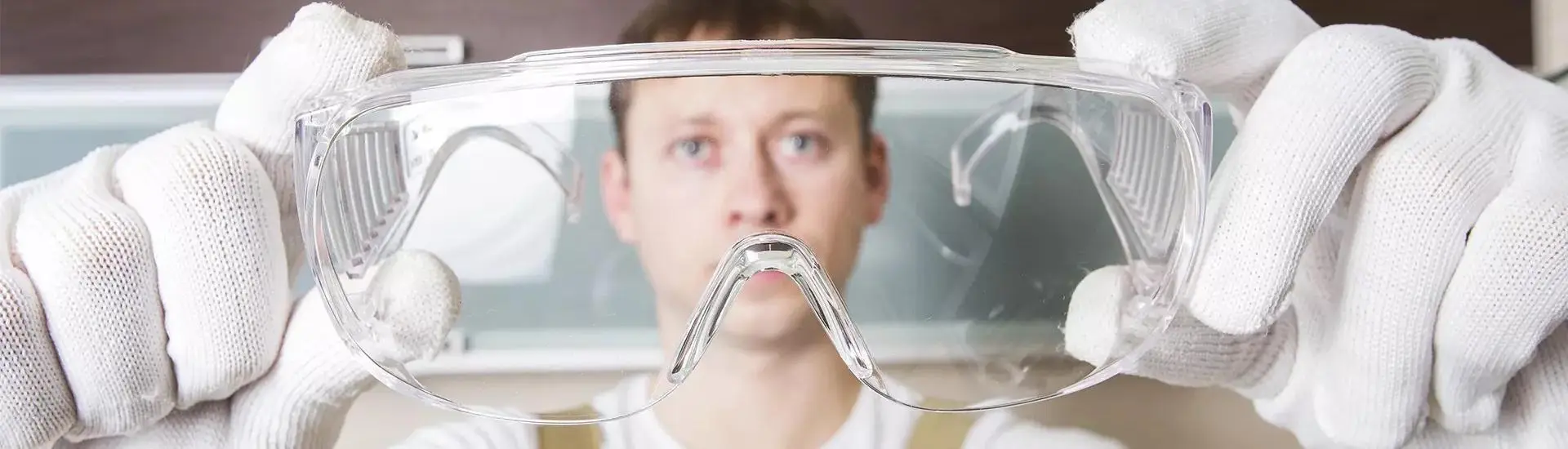
How Eye Protection Has Developed Over Time
Today we have a varied choice of protective eyewear that are custom designed to the job at hand. This and the wide range of style choices make it easy to forget what eye protection was in the past.
Safety eyewear has developed considerably in all its forms over time, and we are taking a moment to appreciate that. In this article, we look at how far the world has come in developing well-rounded eye protection products.
The Origin of Protective Eyewear
The first safety goggles were invented and patented as far back as 1880. Powell Johnson created the “Eye Protector” designed to protect the eyes of ironworkers, firemen, and furnace men.
Johnson created a two-layered semi-opaque cloth design to reduce the dangers of bright light. Unfortunately, Johnson’s configuration did not offer any impact protection. Present-day safety eyewear protects the wearer from impact hazards such as flying fragments.
The Invention of Safety Glass
In 1903, French scientist Edouard Benedictus made a discovery that lead to the amazing invention of safety glass.
Benedictus knocked over a glass flask that had contained cellulose nitrate (a liquid plastic) by accident. Although the flask had broken, he discovered that its pieces still hung together in the same shape. The cellulose nitrate was no longer in the flask, but it had left behind a thin plastic coating.
Soon after this discovery, Benedictus read of a spate of vehicle accidents where shattered glass caused severe injuries. He began to experiment with coating glass with cellulose nitrate, and the result was safety glass.
Although less widely used in protective eyewear now, safety glass was a vital component of its development. Today, materials such as polycarbonate, with its impact and fog resistance, have replaced glass.
The First Safety Eyewear
Julius King was known as America’s first teacher of optics. He was concerned about industrial eye injuries and their frequency.
Taking action, he set up an industrial safety and eye protection department in his company. In 1909, the Julius King Optical Company collaborated with American Optical to produce the first safety goggles. They were known as SANIGLAS.
In 1914, American Optical recognised the need for workers to be protected and still see clearly. It shifted focus slightly to safety prescription lens development. Furnace and melter’s goggles were invented by 1935, protecting workers from impact hazards, glare and harmful light.
Aesthetic Development
For a long time after its inception, eye protection was heavy and incredibly ugly. It was not until 1979 that safety eyewear was able to develop aesthetically.
Until this time, the American National Standards Institute (ANSI) required that protective eyewear be a specific, pre-approved shape. After 1979, safety eyewear could vary in design as long as it passed high-speed and high-impact tests.
Today, safety eyewear comes in varying designs. Most design changes reflect the interest in comfort or increased safety. However, it is common for companies to design for style too.
Material Development
From the 1940s to the 1970s, the only available lens materials were glass and hard resin. These materials were brittle and presented a secondary hazard to the eyes and face when used for eye protection.
In the 1970s, polycarbonate became available; this material has a very high impact resistance likened to bulletproof durability. In the 1980s, the Gentex Corporation introduced protective eyewear lenses made of polycarbonate to the eye protection market. These lenses were the lightest and thinnest available at the time.
Unfortunately, polycarbonate lacks abrasion and some solvent resistance when used as a stand-alone material. Applying hard coatings to it gradually solved the lack of resistance, producing the quality protective lenses of today.
The Development of Anti Fog
Anti-fog technology is a scientific feature that we can thank NASA for inventing. Fogging visors posed severe dangers for space explorers in the past. So, in 1966 an anti-fog solution was developed and sent on a spacewalk with astronaut Eugene A. Cernan.
Eugene tested and proved the efficiency and convenience of the solution, and anti-fog continued to evolve since. Now, this technology is available in sprays, gels, wipes, and, more importantly, coatings applied to safety lenses during the manufacturing process.
Delta Health and Safety Protective Eyewear
Eye protection has changed considerably throughout history, and the innovation continues. Delta Health and Safety endeavours to stay at the forefront of eye protection development.
Delta Health and Safety stocks a wide range of safety spectacles and safety goggles. Our suppliers, such as UVEX and 3M, produce high quality and fashionable eye protection.